
Pizzerias Are Making It Easier to Pick Up Pies
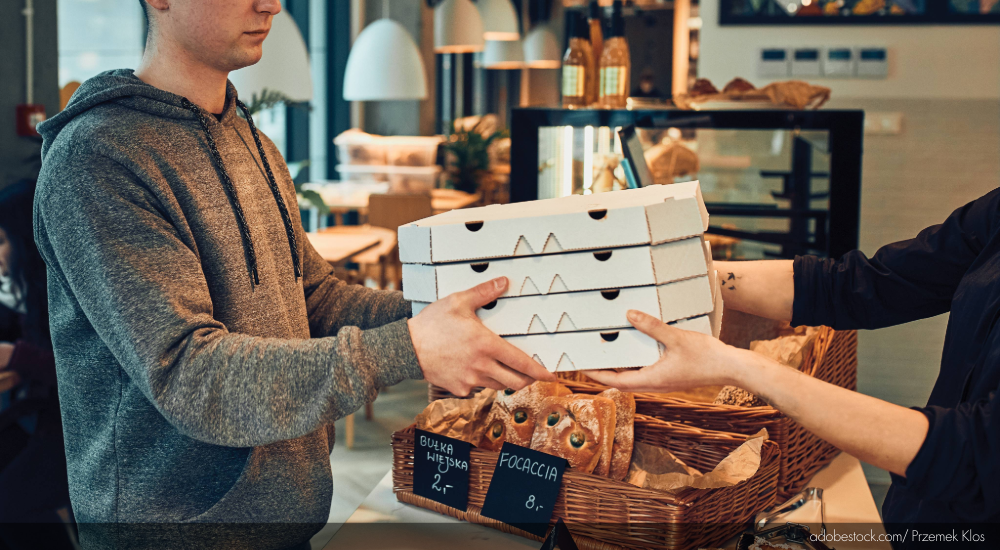
There is a special place for people who order their pizza to go, and that place can be the takeout window, the front counter or a separate entrance. As delivery and carryout continue to gain popularity, pizzeria owners are designing pickup areas that make it easier for carryout customers, dine-in guests and delivery drivers to all peacefully coexist.
Carryout and delivery have always played a role in pizzerias’ success, and third-party platforms have made takeout even more essential. One important aspect of designing this customer-facing area is to make sure it remains inviting and uncrowded.
Keep the Entryway Clear
It is important to prevent delivery drivers from crowding the space where customers are waiting to be seated or to pick up their own orders. Setting up two counters – or two point of sale systems on one counter – can help. Have clear signage directing people to the correct line, and train staff to engage with customers.
At Pizza Delicious in New Orleans, the counter has two lines. One is for customers ordering at the register, and the other is for customers who ordered pickup via phone, online or through DoorDash or Uber Eats. “We don’t want people to get tangled up,” says Mike Friedman, co-owner of Pizza Delicious. “We tell people on the phone, ‘Come to the register on the right.’”
The restaurant reinforces the message with signage, and staff call out or motion to customers to clarify who goes where. Online orders are pre-paid, while phone and in-person orders are paid at the counter, so the goal is to get the pre-paid orders out the door quickly. When a delivery driver shows up, the staff quickly hands over the order to clear the way for customers who are placing their own orders or dining in. That process takes some communications skill to manage expectations.
“I think people could get frustrated if they realize they’ve stood in line and waited longer,” Friedman says. “We might have to tell people, ‘Oh that’s just a driver; we’re trying to get them out.’”
Provide a Separate Entrance
When Glide Pizza moved to its current location in Decatur, Georgia, the pizzeria was designed to prevent some of the congestion issues it had faced in its previous location. “We were doing a lot of to-go orders, and we were having drivers just kind of stand in the middle of everything,” says owner Rob Birdsong. “They were congesting the area, and we really wanted to avoid that.”
The new location has a separate entrance for delivery drivers, who are instructed to use the side entrance – specifically the purple door. Drivers open the door and see the window, warming box and kitchen, a layout that makes it easy for them to pick up orders and exit without ever entering the dining room. Customers who order directly from Glide online (not through third-party delivery services) also can use the pickup window, which is easy to access because Glide Pizza is on a corner lot. “It’s the most direct way in and out of the building,” Birdsong says. “Pizza is one of those foods people want to grab and get back in the car and go where they’re going.”
The pickup window is a familiar setup for Glide Pizza, which opened a walkup window at its Atlanta location during the pandemic – a pivot from Birdsong’s original concept: a lunchtime eatery in Midtown. The walkup window is on the Beltline, a loop of urban trails frequented by cyclists, walkers and other outdoor enthusiasts working up an appetite.
A third Glide Pizza location, planned for a 2026 opening in time for the FIFA World Cup, will have a dedicated pickup window and a courtyard. “Windows have always been part of our DNA, and we will keep it that way,” Birdsong says. “We try to keep it efficient and smooth and clean and clear.”
Leverage Technology
Communication is important, and not just when telling people which line to use for carryout. Futuro Pizza in Indianapolis texts its customers when their pie is ready. That way, customers can approach the counter when the pie is hot and fresh instead of hovering. “This is the model we’ve used since we opened, and we’re on our fifth year now,” says owner Luke Tobias. “It respects people’s time.”
Even customers who order at the counter are asked for their phone number and get sent a text. Occasionally, people don’t want to share their real phone number, or they don’t receive (or read) the text message they are sent. Customers in those instances might arrive at Futuro Pizza when their pie has been sitting for a few extra minutes. But Tobias calls such instances “fairly infrequent.”
The real challenge is balancing the text model with the shortcomings of delivery platforms. With DoorDash, Tobias says, the system has a default prep time the pizzeria cannot change. If a large order comes in, Futuro cannot communicate to customers that their order will take longer than expected.
The solution is to turn off DoorDash on busy Friday and Saturday nights. “Fridays and Saturdays are my bread and butter, and I can’t have drivers trying to put their phone on your forehead,” Tobias says. “We ended up turning it off because there is no middle ground.”
Train Staff
When Bill Harrigan opened his franchise location of Jimano’s Pizza near Milwaukee, Wisconsin, he knew he wanted to focus on delivery and carryout. The location opened in January 2025 and has three tables but no table service. Customers order from one of two cashiers, and Fridays, Saturdays and Wednesdays (when pies are 50% off) are very busy, so orders take longer to complete.
Customers who ordered earlier in the day expect their pizzas to be ready when the system predicted, believing they gave Jimano’s enough lead time to prepare their order. “There is no reason we can’t do it when someone gives us six hours,” Harrigan says. “They’ll say, ‘I definitely am not going to rely on you for a big party.’”
Harrigan’s solution is to train staff about the proper timing for prep work, when to put pies in the oven and other details. “For the most part, we keep the flow going,” he says. “I get most of my complaints if it takes longer than 25 minutes. I just come out and apologize.”
Nora Caley is a freelance writer who covers small business, finance and lifestyle topics.