
Key Points:
- Teaching others to make dough helps free up pizzeria owners to work on growing the business.
- Provide photos and scales to help employees accurately recreate your recipe.
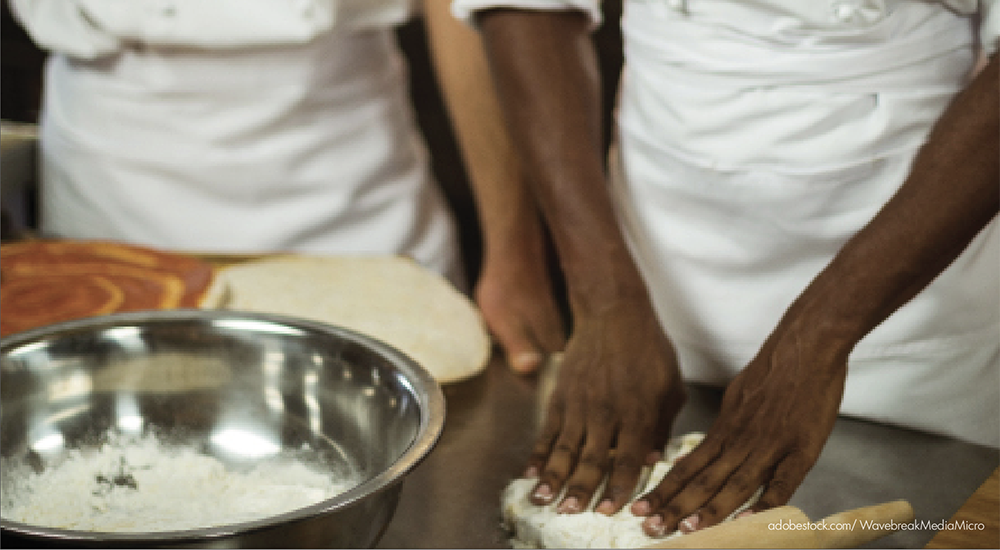
- Allow your staff to touch dough you made, so they know what it should feel like.
Recipes, systems and sensory training help your staff achieve consistency
We’ve all heard at some point that to advance our business and improve our quality of life, we have to learn how to work on the business instead of working in the business. But how do you do that when you are the chef? Dough is the foundation of all pizza and can seem like a daunting task to teach anyone – especially when it’s personal.
As business owners and recipe creators, we all must learn how to let go. Unless you want to be a one-person operation, you will have to trust others eventually.
The first step is to create recipes and procedures. If anyone is going to execute a recipe, it needs to be broken down completely – and not in a way that only you understand it. Instead, a person working their very first day in the kitchen needs to be able to follow it. After all, working in a pizzeria is the first job for a lot of people.

I remember my first job as a teenager in a pizzeria, where I was surrounded by other students in high school or college. We had little experience and skill but a lot of energy. Harnessing that energy in a way that is productive comes down to providing good explanations.
Tips for Writing Recipes
A recipe should include not just instructions and quantities but also the equipment needed. Here are some tips to consider when creating a recipe:
- Provide weights in grams or ounces, not volume (unless liquid).
- Use pictures alongside the steps so people know what they are looking for.
- Recipe layout should be obvious. Start with the equipment they will need, then the ingredients, and then the directions for how to execute.
- Provide translations in Spanish or other languages if English is not the primary language in your kitchen.
- Offer a single-, double- and triple-batch version for each weight to reduce waste.
- Have a par sheet for each day of service and a plan B for holidays or special occasions.
Photo by alexkich/stock.adobe.com
Do you have Pizza Dough Questions?
Whether it’s dough ingredients, process or recipes, we want to know what issues you are having with pizza dough. Are you interested in a new style or technique? Send your questions to Denise Greer at [email protected]. Put “Question for Knead to Know” in the subject line.
Intricacies of Dough-making Instructions
For items such as sauces and toppings, prep can be straightforward, but dough requires a little more attention to detail.
For your dough, tailor your recipes to the mixer you have. If you have a new mixer with a computer, then you can program your recipes down to the minute and increase or decrease the speed accordingly. In this case, all your employees should need to do is weigh out the ingredients and add them at the appropriate times.
For older mixers, this is not the case. You will need to describe in detail when to increase speeds and add ingredients.
The trickiest part is always the water. If you have a temperature-controlled room, fantastic! If you don’t, then you will need to have a plan A, B and C for every season. Having thermometers on the walls is crucial, and they should include a humidity reading.
Every recipe should state timing for each step. But let’s be honest, as soon as employees memorize quantities, they begin to think for themselves. This is why it is helpful to learn the reasons behind decisions. I want my employees to think for themselves, but when changes are needed because of temperature or humidity, their reasons need to be the same as mine.
Tactile Memory
Teaching touch and feel is as important as learning a recipe. Science can be tough to teach – especially if you are dealing with more than one language – but there’s a way to deliver understanding. It doesn’t need to be super detailed, but understanding why more water might be needed during a certain season or why to use ice in the summer but not in the winter will ensure consistency.
When I was teaching how I wanted dough to be made, the recipe was the first step. I had to teach what each step was meant to look like in the mixer, and I’d have trainees touch the dough at each step. Could they feel salt? Could they see remnants of oil? Were there dry pockets of flour at the bottom, or was the water completely absorbed?
There are many visual cues to look for at each point but also sounds. If you are observant enough, your dough will make a specific sound at each step, and it will tell you when it’s done. We don’t want people walking away from the mixer, but if they’re gathering dough trays or setting up for scaling, sounds are just as important. Dough-making is a fully sensory experience, and teaching my employees to use all their senses means they’ll become better pizzaioli.
Pivoting From Mistakes
Finally, it’s time to talk about mistakes. They’re going to happen. Yes, it may be devastating when errors occur, but they do not need to mean a whole service is lost. Your employees need to know how to ask questions when things don’t look right before they get to the end of a mix. Maybe a rest period is needed or a tad more water. If the dough already is in trays and you’re open for service, then teaching your oven people how to pivot when dough is different is just as important as the dough itself. Knowing how to manipulate your oven to the needs of your dough will salvage most errors.
In the end, we teach, we oversee, and then we need to let them do it. Knowing how to pivot when mistakes happen is the quickest way to success and less stress on your end.
Ultimately, the best path forward when teaching employees how to make dough begins with recipes and procedures. Then, focus on the details and plan for all seasons. It can be tough to teach, but most of us love to play with our food, and dough provides one of the best playgrounds.
LAURA MEYER is the owner of Pizzeria da Laura in Berkeley, California.

Photo by Denise Greer; design by Katie Wilson
Read the July 2026 Issue of Pizza Today Magazine
This issue of Pizza Today magazine is dedicated to the employee experience. From our cover story – “Secrets of the Best Workplaces” – to columnist Nick Bogacz’ first-person account of debuting employee programs, we cover everything from creating employee pay scales to restaurant technology that makes your staff’s lives easier. Plus: We dive into the practice of teaching dough-making, local sourcing and pesto. It’s a delicious issue from start to finish.
Check out the full Digital Edition – Pizza Today July 2026.