
Key Points:
-
- Quality of life and decent wages are considered paramount at pizzerias known for prioritizing employee experience.
- Business owners can negotiate insurance and retirement programs at group rates.
- Cross-training and providing clear expectations improves overall employee satisfaction.
Defined roles and training rank highly with competitive pay, insurance and education opportunities
By the time he launched a pizzeria in Reno, Nevada, Marvin Kinney had spent three decades working in kitchens without access to health insurance or a retirement savings account. At R Town Pizza, he wanted to do things differently – and, hopefully, set an example for others.
“I didn’t have health insurance until I turned 44,” Kinney tells Pizza Today. “And I had to build the damn company to do it.”
Employees working more than 32 hours per week at R Town have access to employer-sponsored health, dental and vision insurance as well as automatic enrollment in a 401(k) program after 90 days with immediate vesting and a 4% match. “It’s an automatic opt-in, so you have to opt out of it,” he says.
The offerings are not without significant effort on Kinney’s part: Last year, insurance premiums rose 14%, and there are rumors they could climb up to 20% again this year. Still, he is committed to the program. “I could give all my staff a pretty substantial raise and let them to buy their own health insurance,” he says. “But I have a couple of people – including my own kid – who really need it.”
Be the Change You Wish to See in the Pizzeria
Kinney says much of the restaurant industry is built on a culture of burnout and addiction, where people come to work sick and are rewarded with a six pack of beer. Coming out of COVID, he considered leaving the industry altogether but instead wanted to be an instrument for change.
“I got it in my head that I’ve spent the last 15 years badmouthing the way this industry treats its workers, and so this is my last hurrah. Either I’m going to do this, or I’m going to leave the industry,” he recalls of the decision to open the pizzeria specializing in Detroit-style pies.
The minimum hourly wage in Reno is $12, and Kinney starts everyone at a base wage of $15 per hour. The staff evenly divides a tip pool that works out to an additional $7-$12 per hour. “We start everybody at the same flat rate, so then any raises are all merit-based.”
Earlier this year, he opened Dough Cheese Sauce, a New York-style takeout-only pizzeria located adjacent to an arcade. A manager from R Town moved over to open DCS. “They were fully invested in us, because they believe in what we are doing,” he says, adding that the manager also has invested in the business.
Turning a Corner
Zachary Black is the chief experience officer at Jasons NY Pizza, which has five shops and is headquartered in Bangor, Maine. The family-owned business has been operating since 1997, but ownership took a period of reflection during the COVID pandemic, when they emerged from 2020 with just 10 employees between two stores.
“We always thought we were a good place to work, but were we? Because people could make more money (with COVID-era unemployment benefits) as opposed to staying with us and working,” Black says. “We really shifted our focus, because our business is completely dependent on our employees.”
The family decided to “come back stronger” by investing in employees – noting that at the time, every service-based business was trying to recruit from the same small talent pool. Priorities included making sure employees:
- Have a good quality of life.
- Get paid a decent wage.
Minimum wage in Maine currently sits at $15.25 per hour, and the average pay at Jasons is nearly $21, Black says. Beyond paying more than the minimum, the pizzeria instituted a pay structure, so employees know what kind of raise they might expect, when, and how they can qualify to earn it. Most raises are between 3% and 7%, he adds.
“How do you look forward as an employee if you don’t know that you could make more at this job? … We need these people to be here for years,” he tells Pizza Today.
Keeping Time
Jasons NY Pizza asks managers to cap their hours at 42 hours per week. “They’ve got families and things to do outside of work,” Black says. “Embracing that and the pay have been two really big things for us.”
Additionally, all Jasons NY Pizza employees are eligible for paid vacation time, whether they are part-time hourly employees or full-time managers. “Vacation time goes up with longevity at the company,” he says. “The managers are flexible, and they know that’s our company’s mission: that employees have a good place to work.”
Setting Expectations
In Royersford, Pennsylvania, many teenagers get their first work experiences at Red Top Pizza by Penny’s. Owner Jennifer Boehmer tries to make the transition as smooth as possible by outlining duties and expectations for every role at the carry-out and delivery-only shop.
She does this by sharing “key result areas,” which are printed out, delivered to employees and posted around the pizzeria. The page for the counter position, for example, breaks down responsibilities related to customer interaction, order accuracy, quality control and workspace maintenance. Not only are the tasks listed (ex: sanitize surfaces and equipment regularly) but “what winning looks like” is clearly spelled out. (For example: The counter area is always clean, stocked and organized, leaving a positive impression on customers and supporting smooth service.)
As a result, Boehmer and Red Top Pizza have garnered a reputation around town for developing responsible workers who understand what is expected, what to do during downtimes and how to work as a team during rush periods. “If you see somebody’s busy and are not sure how to help, you can always grab their list,” she says of the system. “My main goal is really just to help develop them as a good, respectable employee, no matter where they go.”
Cross-training Employees
Once new employees excel at the tasks they are hired to do, Boehmer prioritizes cross-training workers on different roles. “If somebody calls out, the delivery driver also knows how to wash dishes, fold boxes, sweep the floor,” she says, adding that cross-training helps employees perform at the highest level. Having counter employees trained on pizza-making, for example, is useful when customers have questions about ingredients.
When it comes to training employees, Boehmer prefers to show workers how to do tasks and then have them repeat the process for her. “There are so many different ways people learn,” she says.
The pizzeria’s full-time manager started working at the shop at age 14 and is now 30. Other positions include pizza maker, oven tender, counter and dishwasher. Boehmer posted a checklist detailing how to open and close every station. When longtime employees balked at the checklists’ arrival, she told them, “Not everybody’s been here forever.”
Celebrating Longevity
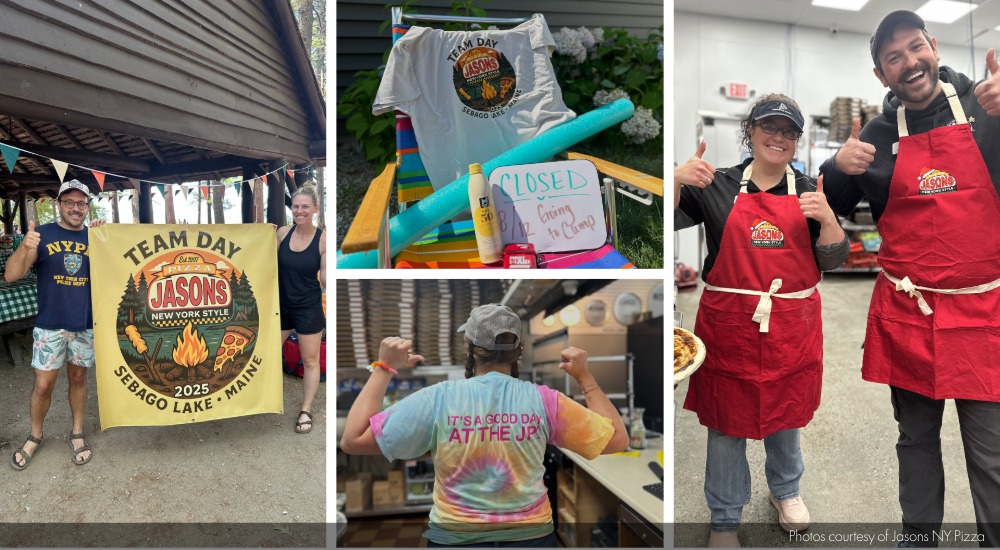
Once per year, Jasons NY Pizza locations close completely for a company-wide party – this year, they held a lobster bake at a state park – when employees are recognized for their tenure at the pizzeria.
“Seven years ago, we would close at 4 or 5 p.m., and we’d do a dinner with everyone. But people have been at work all day. They’re covered in pizza sauce and flour, and they want to go home and shower,” Black says. With the new policy, “Attendance is up because people don’t have to stress about work at all.”
At the party, store managers present employees who have been at the company for at least two years with customized clothing and pins commemorating how many years of service they have at the pizzeria. Last year, Jasons gifted longtime workers with zip-up sweatshirts that had employees’ names embroidered on the back.
Staff members get an updated pin for each year they are with the company, and Black says the employees are quick to point out when they have an anniversary so they can add an updated pin to their work attire.
“It matters because it’s a conversation starter,” he says. “People like recognition, they like being thanked. It goes a long way.”
Industry Admiration
For Kinney, who initially sought to lead by example with the benefits he offers at R Town Pizza, he says other local chefs and fellow restaurant owners regularly seek input about how he achieves the feat. “They’re kind of enamored that we were able to pull it off,” he says, adding that he incurs other smaller costs such as reimbursing staff for half the price of their shoes to get them to invest in durable footwear.
For his part, Kinney is right beside his employees in his own pair of non-slip shoes. On tough days, he wants staff to know he is right by their side.
This also is where Kinney hopes he is changing the culture, one step at a time. “I hope that they take these things with them to their next jobs – or they open their own businesses, and when they become leaders, they take those changes with them.”
KATE LAVIN is Senior Editor at Pizza Today.
Photo by Denise Greer; design by Katie Wilson
Read the July 2026 Issue of Pizza Today Magazine
This issue of Pizza Today magazine is dedicated to the employee experience. From our cover story – “Secrets of the Best Workplaces” – to columnist Nick Bogacz’ first-person account of debuting employee programs, we cover everything from creating employee pay scales to restaurant technology that makes your staff’s lives easier. Plus: We dive into the practice of teaching dough-making, local sourcing and pesto. It’s a delicious issue from start to finish.
Check out the full Digital Edition – Pizza Today July 2026.