

Meet, connect and grow together at Pizza Expo 2026
Beer & Bull has long been a gathering spot for Pizza Expo attendees to meet and talk shop after a full opening day at the show. It’s a place where operators directly meet each other, form lasting friendships and build a networking community.
This year, we’ve reinvigorated Beer & Bull as the ultimate networking event where pizza makers, operators and industry legends come together to talk shop, learn from each other and have a little fun over a cold one.
In the spirit of Beer & Bull’s idea exchange, we connected with industry pros who are Pizza Expo regulars to get their takes on some topical industry issues. In a Q&A, operators share how they approach areas such as using AI to run their businesses, third-party considerations, most effective marketing mediums, dine in/carryout/delivery mix and menu-engineering strategies.
Artificial Intelligence (AI)
How have you explored or implemented AI tools to market your pizzeria? What results have you seen so far?
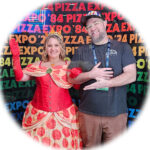
Amanda and Patrick Elston
Gus Franco’s Pizza
Lower Burrell, Pennsylvania
Patrick & Amanda Elston: We’ve done a little bit of research in AI phone-answering systems but have yet to believe it’s the right move for us currently. We have used a little AI in a photo-editor app, by removing backgrounds and color adjustments. The photo editor has helped free up a little time when it comes to preparing our social media posts.

John Rae
Via Farina
Omaha, Nebraska
John Rae: In regards to AI in the business, I have been reluctant to this point, but more so because I’m old school. I struggle with the idea of a mistake being made by AI when a lot of times human error can be such a great way to learn and grow. That being said, I also know that it is becoming an important part of business and I need to start familiarizing myself. One of my focuses at Expo this year is going to be gaining at least some knowledge of AI with hopes of putting some new and improved practices to use in 2026.

Louise Joseph
DoughGirls
Greenwich, Connecticut
Louise Joseph: We have used AI mainly for our IG stories. It’s a fun way to represent our brand while engaging with our customers. The results have been a lot more comments on our stories.

Joe Ledwidge
Ranger Joe’s Pizza
Kalispell, Montana
Joe Ledwidge: I believe AI absolutely has a place in pizza marketing – and in the restaurant industry as a whole. In many ways, it’s adapt or fall behind. The key is figuring out how you want to use it. One thing I’ve learned is that people don’t really want the face of a brand to be AI. When the owner or brand identity starts feeling artificial, it muddies the waters and confuses people.
That said, AI is an incredible tool when it’s used to elevate what you’re already doing. It works great for highlighting processes, creating fun or quirky characters, or building engaging backgrounds and concepts. The funny, off-beat stuff tends to get the most traction. But when it comes to your actual food – your pizza – that should stay real. Lifelike, original photography always wins there.
I’ve been using tools like Google Flow and ChatGPT to help with backgrounds, concepts and themed promos – Super Bowl, National Pizza Day, things like that. It makes creating the bulk of the content fast and efficient, and then you layer in your own design, personality and real visuals. When you marry AI with authentic brand elements, it becomes a powerful creative partner instead of a replacement.

David Whiskers
B.C. Pizza
Boyne City, Michigan
David Whiskers: We have found that our customer base likes the creativity.
What challenges or hesitations have you faced when considering AI for your business?
Patrick & Amanda Elston: We believe AI could look at sales data and organize it in a much faster way. It could use that data to help optimize your menu and gain a better understanding of your customers’ needs and wants.
Louise Joseph: Two big challenges for us are staying authentic. It’s one thing to change the lighting on a photo, but we do not want to catfish our customers with unrealistic images. Also, finding the time to familiarize ourselves with all the AI tools.
David Whiskers: We have found that the likeness of our branding does not meet our standards.
In what ways do you think AI could help you better understand your customers and their preferences?
Patrick & Amanda Elston: We are fairly old-school in how we run our shop, as we take orders by phone or in person only. We are nervous that our customers, new and old, won’t like speaking to a computer instead of a person.
Louise Joseph: AI is great for analytics. After doing this for 10 years, we know which pizzas sell more in certain locations. However, AI dives deeper, like predicting best sellers and even suggesting specials.
David Whiskers: AI can be useful to gain information like market trends and purchase habits.
Third-party Delivery
How have third-party delivery platforms impacted your business?
Patrick and Amanda Elston: We have chosen not to use any third-party delivery – or any delivery at all. We do takeaway only, with some outdoor seating during the nicer weather months. Surely, we would do higher volume, as we have multiple people asking weekly for delivery. But we are happy to be in a position where we don’t need to deliver (other than delivering on quality).
John Rae: We have taken a hard stance against using third-party delivery services. Some are certainly better than others, and it is absolutely a revenue stream we would like to have. The simple fact is that our food doesn’t travel all that well when we are in control of the variables. When we combine taking variables out of our hands and the poor attitude of the vast majority of third-party delivery drivers (in my experience) we have decided it is not a benefit to our brand, and our focus should be on guests inside our locations.
Louise Joseph: The obvious con of third-party deliveries is cost on both the consumer and businesses. The pro is customer convenience and exposure for our business. However, being a food truck makes this tricky. We are in multiple locations and cities, so a customer that ordered from us last week may not be able to do so the next week, as our location is now 15 miles away as opposed to 6-7 miles away (and yes, we said 6-7).
Joe Ledwidge: Offloading deliveries to third-party services has definitely helped from a business standpoint. It reduces the need to carry additional employees on payroll – along with benefits, insurance, and the risk of on-the-job injuries. From an operational perspective, that flexibility can be a real advantage.
That said, there are clear downsides. You don’t control how those drivers interact with your customers, how professionally they represent your brand, or what condition the product is in when it reaches the customer’s door. Sometimes they don’t even use proper delivery bags, which directly affects food quality.
At this point, it’s something you have to accept as part of how the world has shifted. The key is understanding the limitations, being aware of the pitfalls and doing everything you can on your end to set the food up for success within that system. You work within the framework, manage what you can control and strive to be the best possible operator – even when the resources aren’t entirely yours.
Brand identity is extremely important to me, and when orders go through a third-party delivery service, packaging becomes the primary way to protect and communicate that identity. The moment the pizza arrives at a customer’s door, the box is often the only branded touchpoint they see. That’s why our branded pizza boxes matter so much. When a customer opens the door, they see our name, our phone number and our brand – front and center – even if a third-party driver is the last person to handle the order. The packaging keeps the connection between us and the customer intact, reinforces who we are and ensures our brand doesn’t disappear just because the delivery wasn’t done in-house.
David Whiskers: These have helped us stay relevant in bigger markets.
Marketing Mediums
How do you measure the success of your marketing efforts?
Patrick & Amanda Elston: Our marketing is only measured by conversations with our customers as they come in for pickups. Our marketing is done mainly on social media posts and live streams. Many people mention something they saw on Facebook or Instagram, and we also see larger sales numbers for whatever was featured that day or week.
Louise Joseph: We do compare sales history from events. Also, our POS system gives us analytics such as new and returning customers. We also keep weather history, as that is a huge factor as a mobile business.
Joe Ledwidge: Our primary marketing channels are Facebook and Instagram, along with e-mail marketing and some SMS text campaigns. On the data side, Toast provides a very detailed analytics hub that allows us to measure the effectiveness of our email campaigns: tracking e-mails sent, delivered, opened or rejected. It also shows total revenue generated from those campaigns – including customer order frequency within roughly three to four days – and delivers a clear performance summary at the end of each campaign.
Social media works a little differently. With Instagram and Facebook, the value is in engagement – likes, comments and direct interaction with our customers. When someone takes the time to comment on a post, I always try to respond. It’s important to me that people know we’re present, listening and engaging with them throughout the adventure they’re sharing with us.
David Whiskers: Menu view clicks, Redemption rates.
Have you experimented with newer marketing mediums, such as influencer partnerships or TikTok?
Patrick & Amanda Elston: We’ve been fortunate to have multiple food influencers come by our shop and enjoy what they ordered. Not sure if that’s partnering with them, as no payment for their posts were ever made. The outcome of what we’ve experienced has been very positive, with a large number of first-time customers trying us out, even months after the post originally hit.
Louise Joseph: We have had some influencers, and they have helped but nothing dramatic. One influencer wanted to do a “Day on the Truck” but could not handle the heat … literally.
David Whiskers: Yes, Lots of views and shares.
How do you tailor your marketing strategies to appeal to your local community?
Patrick & Amanda Elston: We sponsor local teams, fundraisers and events. We talk about the employees that our customers see when they come grab their pizzas. We talk about the neighborhood and try our best to be fully engaged in it.
Louise Joseph: We frequently partner with local business and make sure we highlight them at all our events. If they aren’t camera shy, we also like to include our repeat customers because after all, they keep us going.
Joe Ledwidge: Everything we do is intentionally tailored to our local community. We keep a strong Montana vibe in our messaging and visuals, and we make sure our marketing reflects the sense of adventure that defines our brand. No matter the platform, that flavor of adventure is always at the center of what we put out into the world.
David Whiskers: Smaller communities, we do mail marketing and radio ads. Larger communities, we focus more on social media.
Menu Engineering
Have you made any changes to your menu recently to improve profitability or meet customer demand?
Patrick & Amanda Elston: We recently added a small section to our menu called “Fan Favorites,” where we started offering two past specials that never really went away, as people would continue to order them and ask for them all year long. So far, they are some of our best-selling pizzas this year.
John Rae: We make changes to our menu three to four times per year. Some could be considered seasonal, and some could be more just freshening up. We used to have a little more of an overhaul every time – and during the pandemic, when we took the opportunity to really solidify our brand, we built our menu with what we refer to as the “hit list.” Most of our menu doesn’t change at this point, but rather we have some fun with our specials we run on the weekends. Those can by focused on seasonal ingredients, a promotional item that we got from a vendor or just something that we want to do. Often times, our menu items that end up on the menu when we do a change are items that we ran as a special and got a great response. The other pieces of data we look at when doing a menu change is real-time cost of goods combined with sales percentage.
Louise Joseph: We learned to streamline our menu according to the event location. Knowing what sells more based on location is important for our bottom line. People like options, but too many options cause indecisiveness, which creates longer wait times. Keeping it simple is a win for everyone.
TO PARTICIPATE IN BEER & BULL, REGISTER FOR PIZZA EXPO 2026 TODAY!